
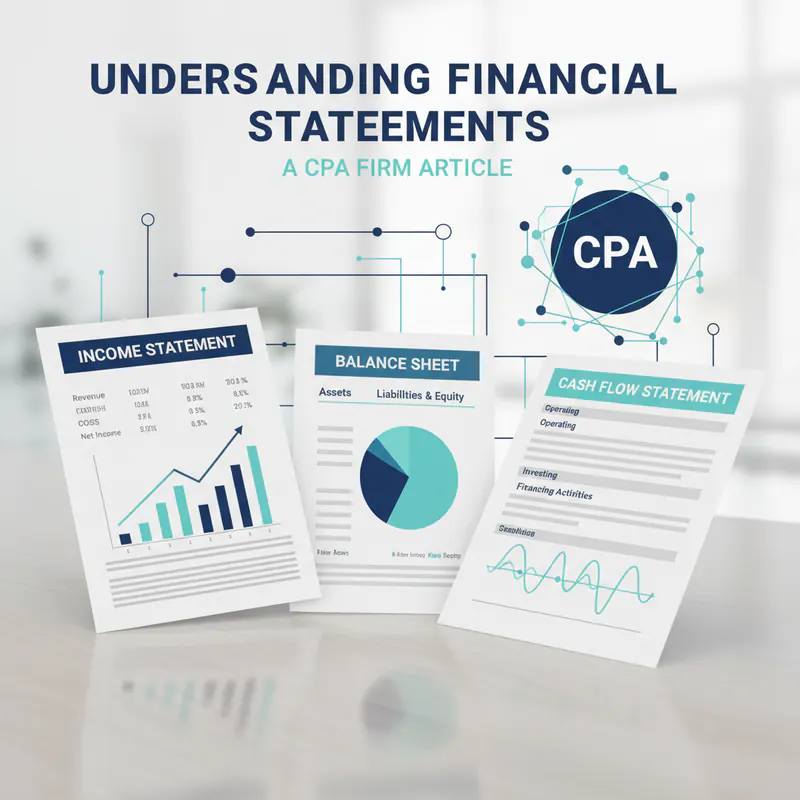
Income statement, balance sheet, cash flow statement. What do they mean and how should you use them to make decisions?
Many business owners receive these reports monthly and file them away without really understanding what they reveal. That's a missed opportunity.
This guide breaks down the three core financial statements and shows you how to use them together.
The Three Essential Statements
Think of your financial statements as three different views of the same business:
- Income Statement: How profitable were you over a period of time?
- Balance Sheet: What do you own and owe at a specific point in time?
- Cash Flow Statement: Where did your cash come from and where did it go?
Each tells part of the story. Together, they provide a complete picture of financial health.
The Income Statement (Profit and Loss)
The income statement shows revenues minus expenses over a specific period, typically monthly, quarterly, or annually.
Key Components:
- Revenue (Top Line): All income from sales of products or services.
- Cost of Goods Sold (COGS): Direct costs to produce what you sold: materials, direct labor, manufacturing overhead.
- Gross Profit: Revenue minus COGS. This shows how efficiently you produce your product or service.
- Operating Expenses: Costs to run the business: rent, utilities, salaries, marketing, insurance.
- Operating Income: Gross profit minus operating expenses. This is profit from core business operations.
- Net Income (Bottom Line): What's left after all expenses, interest, and taxes.
What to Watch:
- Gross margin percentage: Is it stable or declining?
- Operating expenses as a percentage of revenue: Are you spending efficiently?
- Net profit margin: What percentage of revenue becomes actual profit?
The Balance Sheet
The balance sheet shows what you own (assets), what you owe (liabilities), and the difference (equity) at a specific point in time.
Assets = Liabilities + Equity
Assets (What You Own)
Current Assets are items that will convert to cash within one year:
- Cash and bank accounts
- Accounts receivable (money customers owe you)
- Inventory
- Prepaid expenses
Non-Current Assets are long-term holdings:
- Equipment and machinery
- Buildings and land
- Vehicles
- Intangible assets (patents, trademarks)
Liabilities (What You Owe)
Current Liabilities are due within one year:
- Accounts payable (money you owe vendors)
- Short-term loans
- Accrued expenses
- Current portion of long-term debt
Long-Term Liabilities are due beyond one year:
- Bank loans
- Equipment financing
- Mortgages
Equity (Net Worth)
What remains if you paid off all debts:
- Owner's capital contributions
- Retained earnings (accumulated profits not distributed)
The Cash Flow Statement
The cash flow statement tracks actual cash movement, organized into three categories.
Operating Activities
Cash generated from core business operations:
- Collections from customers
- Payments to suppliers and employees
- Interest and tax payments
Investing Activities
Cash used for long-term investments:
- Purchasing equipment
- Selling assets
- Acquisitions
Financing Activities
Cash from funding sources:
- Loan proceeds and repayments
- Owner contributions and distributions
- Dividend payments
Why It Matters:
A profitable company can still run out of cash. The income statement includes non-cash items like depreciation. The cash flow statement shows what actually happened to your bank balance.
Ideally, cash from operating activities should exceed net income. That indicates your profits are real and collectible.
Common Mistakes Business Owners Make
Focusing Only on the Income Statement: Profit looks great, but cash is tight. Why? Check the cash flow statement. You might have money tied up in receivables or inventory.
Ignoring the Balance Sheet: The income statement shows one month's results. The balance sheet reveals accumulated financial health or stress.
Confusing Profit with Cash: A $50,000 sale doesn't put $50,000 in your bank account until the customer pays. Many profitable companies fail because they run out of cash.
The Bottom Line
Financial statements aren't just compliance documents for your accountant. They're management tools that reveal what's really happening in your business.
Review them monthly. Ask questions when something looks off. Over time, you'll develop intuition for what the numbers mean and how to use them.